
When we booked our winter escape from Manchester to Doha in late December 2025, we imagined golden dunes, futuristic skylines, and quiet coastal forts. What we didn’t anticipate was how much our choice of transportation would shape what we actually got to see.
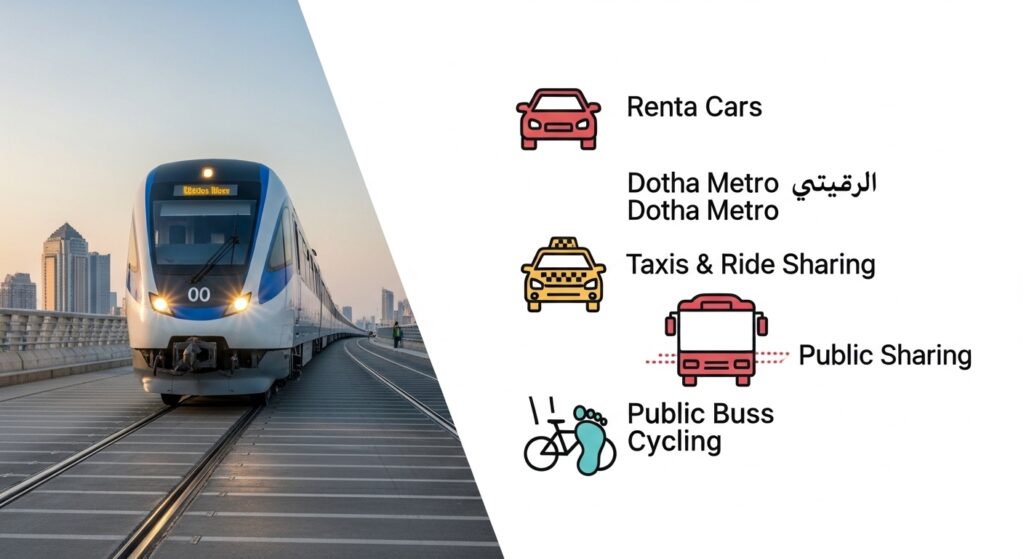
Over the course of seven days, we three friends tested every major transportation option available to tourists: the metro, city buses, taxis, ride-hailing apps, and, finally, a rental car. Here’s a side-by-side comparison of what each option offers, where it falls short, and what we experienced.
Whether you’re a solo traveler on a budget or a group chasing adventure, this guide will help you choose the best way to move through Qatar.
We Tried Every Way to Travel in Qatar – What Actually Made Sense
Doha Metro: The Backbone of City Travel (But Only in the Core)
The Doha Metro is often hailed as one of the most advanced public transit systems in the Middle East—and for good reason. Launched ahead of the FIFA World Cup 2022, it now spans three lines (Red, Green, Gold) covering key urban zones. As tourists, we relied on it heavily during our first two days.
We bought Karwa Smartcards right at Hamad International Airport for a QR10 refundable deposit and loaded QR40—enough for nearly a week of short rides. Fares range from QR2 for a single zone to QR10 for cross-city trips, making it one of the cheapest ways to navigate central Doha. Trains arrive every 3–5 minutes during peak hours, run from 6 AM to 11 PM, and are fully air-conditioned, spotless, and driverless.
Using the Red Line, we reached Msheireb Downtown in under 25 minutes from the airport, then walked to Souq Waqif—a seamless start. The metro also connects directly to major attractions like the National Museum of Qatar, Katara (via Lusail station + shuttle), and West Bay’s business district.
But here’s the reality: the metro only serves central and northern Doha. There’s no line to the southern desert, the western forts, or even the full length of the Corniche. When we tried visiting the Museum of Islamic Art, the closest station left us with an 18-minute exposed walk in 25°C sun—not ideal with daypacks and midday heat. And forget about reaching places like Al Zubarah or Khor Al Adaid; they’re over 80 km away, with zero rail coverage.
For solo travelers sticking to downtown Doha, the metro is excellent. But if your Qatar dream includes deserts, beaches, or historical sites beyond the skyline, public transport in Doha simply won’t get you there.
Karwa Buses: Budget-Friendly but Limited by Traffic and Coverage
After the metro, we turned to Karwa buses, Qatar’s official public bus service. They integrate with the same Smartcard system, and many intra-city routes cost under QR5—some even free with a daily pass. Buses like the 777 (to The Pearl) and 555 (to Education City) are modern, equipped with Wi-Fi, USB ports, and real-time tracking via the Karwa app.
We took Bus 777 to The Pearl-Qatar on Christmas Eve and were impressed by the comfort and low cost. However, on the return journey, we hit rush-hour traffic near the Lusail Expressway and sat motionless for nearly 70 minutes. With no dedicated bus lanes, Karwa services are just as vulnerable to Doha’s growing congestion as private cars. Schedules exist, but on-time performance drops sharply outside of off-peak hours.
More critically, bus routes rarely extend beyond Greater Doha. There’s no service to Sealine Beach, Al Thakira Mangroves, or Zekreet—places that define Qatar’s natural beauty. Even if a route exists on paper, frequency can be as low as one bus every 90 minutes, making day trips impractical.
While Karwa buses are a solid supplement to the metro for budget-conscious travelers exploring urban zones, they’re not a viable solution for independent exploration of Qatar’s wider landscapes.
Taxis & Ride-Hailing: Door-to-Door Convenience at a Rising Cost
For quick hops, we used both official Karwa taxis (easily identifiable by their turquoise color and metered fares starting at QR10) and apps like Uber and Careem, which operate widely across Doha.
A typical ride from West Bay to Souq Waqif costs around QR28–35, while longer trips, like to Katara Cultural Village (15 km north). The convenience was undeniable: no parking stress, no navigation, and drivers often shared local insights.
But the downsides emerged fast. On December 25, leaving Katara at 6:30 PM, surge pricing on Uber doubled our fare from QR48 to QR94. Careem showed similar spikes. During peak evening hours or events, ride-hailing prices can jump 80–120% above base rates. For a group of three doing multiple trips daily, costs quickly surpassed QR300 ($82) in just two days.
Moreover, taxis won’t wait while you explore. Want to spend two hours at a desert viewpoint? You’d need to pay for a round-trip plus waiting time—or risk being stranded. And for remote areas like the Inland Sea (Khor Al Adaid), most drivers charge flat rates of QR250–350 round-trip and refuse to stay longer than 30 minutes.
Taxis and ride-hailing are perfect for short, occasional trips or late-night returns, but they’re not sustainable for full-day touring or off-grid adventures.
Rent a Car: The Only Way to Unlock the Real Qatar
On December 26, we finally did what we should’ve done from the start: we rented a car—and it completely changed our trip.
After scrolling through countless options for affordable car rental in Qatar, we booked a Toyota RAV4—the most commonly rented SUV in the country. We chose it for its reliability, comfortable ride, and enough ground clearance to handle light desert tracks near Sealine.
I suggest booking online through Final Rentals and selecting Hamad International Airport as your car rental pick-up location, and start your trip without relying on public transport.
With our UK driving licenses and International Driving Permits (required for all non-GCC visitors), we were in and out of the rental counter in under 20 minutes. The agent walked us through the vehicle, confirmed that full insurance was included, and handed over the keys. Our rate? $39 per day—significantly better than the $60+ we saw quoted on-site for the same model when we peeked at walk-in prices.
Fuel in Qatar is still among the cheapest in the world: just $0.53 per liter (QR1.95). Filling the RAV4’s tank set us back only $24 (QR88)—enough to cover nearly 500 km of city and desert driving.
And parking? Surprisingly stress-free. Most Doha malls, like Mall of Qatar or City Center, offer 3–4 hours of free parking, and even in heritage zones like Souq Waqif, street parking costs just $2.75–$4 per hour (QR10–15). For a vehicle that gave us total freedom across the country, the whole setup felt almost too easy.
With a renal car in hand;
We drove 80 km south to Khor Al Adaid, a UNESCO-listed inland sea where dunes meet the Gulf—no public transport, no taxi willing to wait.
We explored Al Zubarah Fort, a 250-year-old pearl-trading hub, then detoured to Zekreet Beach, where limestone cliffs meet turquoise water—zero bus access.
We kayaked through the Al Thakira mangroves, spotting herons and crabs in tidal channels—only reachable by private vehicle.
We even discovered purple-tinted dunes near Dukhan, caused by rare mineral deposits—something no tour operator mentioned.
Most importantly, we gained time autonomy. No schedules. No waits. No surge fees. Just freedom to follow a sign, stop for sunset, or change plans on a whim.
For a group of three, splitting the daily cost meant just QR48 (~$13) per person per day—cheaper than two Uber rides. And compared to missing half the country, it was priceless.
If you plan to rent, booking online at least 3 to 7 days before travel not only secures better rates but guarantees availability—especially critical during Qatar’s peak winter season (November–March), when demand surges.
So, What’s the Best Way to Get Around Qatar?
It depends entirely on your itinerary:
- Stick to downtown Doha? Use the metro + walking. It’s efficient, cheap, and covers Souq Waqif, MIA, the National Museum, and West Bay.
- Traveling solo on a tight budget? Combine metro and Karwa buses, but accept limited range and potential delays.
- Need occasional convenience? Use Uber/Careem for short trips, but avoid peak hours to dodge surge pricing.
- Exploring deserts, forts, beaches, or traveling with others? Rent a car in Qatar. It’s the only way to access 70% of the country’s most breathtaking sites—and often the most economical for groups.
Final Tips for Getting Around Qatar as a Foreign Visitor
- Always carry your passport and driving license—police checkpoints are common outside Doha.
- Get an International Driving Permit (IDP) before flying if you hold a UK, EU, US, or Australian license—it’s required by all rental companies.
- Download offline Google Maps—cellular signal fades in desert regions.
- Carry Qatari riyals in cash—many desert entry points (e.g., Khor Al Adaid: QR20) don’t accept cards.
- Book your Doha airport car rental online in advance—rates rise 30–50% at the counter, and popular models sell out fast in winter.
Frequently Asked Questions
What’s the best way to get around Qatar as a foreign tourist?
For short stays focused only on central Doha—like Souq Waqif, the Museum of Islamic Art, or West Bay—the metro and Karwa buses offer cheap, efficient public transport in Doha. But if you plan to visit deserts, forts, or coastal areas like Khor Al Adaid or Al Zubarah, renting a car is essential. Ride-hailing apps like Uber work for occasional trips but become expensive for groups. Ultimately, renting a car in Qatar gives you freedom, better value for 2+ people, and access to 80% of the country’s hidden gems that public transit simply doesn’t reach.
Do I need an International Driving Permit (IDP) to rent a car in Qatar?
All non-GCC nationals—including visitors from the UK, US, Canada, Australia, and EU countries—must present a valid home-country driver’s license plus an International Driving Permit (IDP) to rent a car in Qatar. Rental companies strictly enforce this rule. The IDP acts as a certified translation of your license and is required by Qatari traffic law. You can obtain one from your national automobile association or post office before travel—it’s not available in Qatar.
Is it safe to drive in Qatar as a tourist?
Driving in Qatar is generally safe for tourists. Roads are well-maintained, clearly signposted in English and Arabic, and traffic laws are strictly enforced. However, local drivers can be fast or change lanes abruptly, especially during rush hour in Doha. Stick to speed limits (typically 60–120 km/h depending on the road), avoid using your phone while driving, and always wear seatbelts. For desert driving near places like Sealine, stick to marked tracks unless you have a 4×4 and experience.
How much does it cost to rent a car in Qatar for a week?
A standard compact SUV like the Toyota RAV4—the most commonly rented vehicle in Qatar—costs between $35–$50 per day when booked online in advance through providers offering affordable car rental Doha airport services. For a 7-day rental, that’s roughly $245–$350 total, including full insurance. Walk-in rates at the airport counter often start at $60+/day.
Can I rely on public transport to visit the desert or northern Qatar?
No, you cannot. Metro and Karwa buses—only serve Greater Doha and nearby suburbs like Lusail or Education City. Destinations like Khor Al Adaid (Inland Sea), Al Zubarah Fort, Zekreet Beach, or the Al Thakira mangroves have no bus routes, no metro access, and limited taxi availability. Even if a taxi agrees to take you, they typically charge QR300+ round-trip and won’t wait while you explore. To truly experience these iconic sites, renting a car in Qatar is the only practical and affordable option for independent travelers.
What is the best place to pick up a rental car in Qatar?
The most convenient and time-saving option is Doha airport car rental pickup at Hamad International Airport (DOH). Major providers have desks right in Terminal 1—no shuttles or extra transfers needed
How much does parking cost in Doha, and is it easy to find?
Parking in Doha is generally easy and affordable. Most major malls—such as Mall of Qatar, City Center Doha, and Villaggio—offer 3–4 hours of free parking. In heritage areas like Souq Waqif or Katara Cultural Village, street or lot parking costs QR10–15 per hour (about $2.75–$4). Many hotels provide free guest parking. Street parking in West Bay may require a paid zone (via SMS or app), but spaces are plentiful outside rush hour. Unlike cities like London or New York, Doha rarely has severe parking shortages.
Are taxis or Uber cheaper than renting a car in Qatar?
For one or two short trips, taxis or Uber/Careem are fine—but for full-day exploration or group travel, renting a car is significantly cheaper. A typical Uber ride in Doha costs $8–$15; surge pricing can double that during evenings or events. Three daily rides per person could easily exceed $45/day—more than half the cost of a shared rental car. Plus, taxis won’t wait at remote sites like desert dunes or beaches. When you factor in flexibility, waiting time, and access, car rental options offer far better long-term value for anyone staying more than 2–3 days.
What type of car should I rent to explore Qatar comfortably?
For most travelers, a compact SUV like the Toyota RAV4 is ideal. It’s the most rented vehicle in Qatar because it offers good fuel efficiency, comfortable seating for 4–5, decent ground clearance for light desert access (e.g., Sealine entry roads), and reliable performance in both city and highway driving. Avoid sedans if you plan to visit sandy areas—they lack clearance. While 4x4s like the Land Cruiser are great for deep dune driving, they’re unnecessary (and more expensive) for 95% of tourist routes, which are fully paved or have firm sand tracks.
I drive my rental car into the desert or to Khor Al Adaid?
You can drive a standard rental SUV like a Toyota RAV4 to Khor Al Adaid (Inland Sea)—but only on the main access road up to the official viewing area. The final stretch onto soft dunes requires a 4×4 and off-road experience, which most rental agreements prohibit. Stick to marked tracks, carry extra water, and ensure your tires are properly inflated. Entry to the protected area costs QR20 (cash only). Always inform your rental provider of your plans; some may restrict desert driving, though many reputable Doha airport car rental services allow it on approved routes as long as you avoid deep sand.
The Bottom Line
Qatar’s magic doesn’t live only in its glittering towers—it’s in the silence between dunes, the salt on mangrove leaves, and the golden light over ancient ruins. But those places don’t sit beside metro stations or bus stops.
If your goal is to truly explore Qatar, not just visit Doha, then renting a car isn’t a luxury—it’s a necessity. And with careful planning—like booking an affordable, reliable car rental online before you fly—you’ll gain not just wheels, but the freedom to discover the Qatar few tourists ever see.