Hiring is often treated as the default answer to a skills gap. A team is overloaded, a deadline is slipping, a client expects faster delivery, or a new project needs capabilities that do not exist in-house. The immediate reaction is usually to open a role and start recruiting.
But that is not always the smartest move.
In many situations, the issue is not that the business needs another full-time employee. The issue is that it requires the right expertise at the right time for the right duration. That is a very different problem. And when businesses misread it, they often end up with slow hiring cycles, delayed projects, and fixed costs that outlast the actual need.
Staff augmentation consulting becomes a more practical option in this scenario. It gives companies a way to strengthen delivery without forcing every business challenge into a permanent hiring decision. For leaders trying to balance speed, cost, flexibility, and execution, that distinction matters a lot.
The real question is not “Who should we hire?”
The better question is: what kind of need are we solving?
Some needs are permanent. Some are temporary. Some are highly specialized. Some are urgent. Some require long-term ownership. Others require immediate execution support.
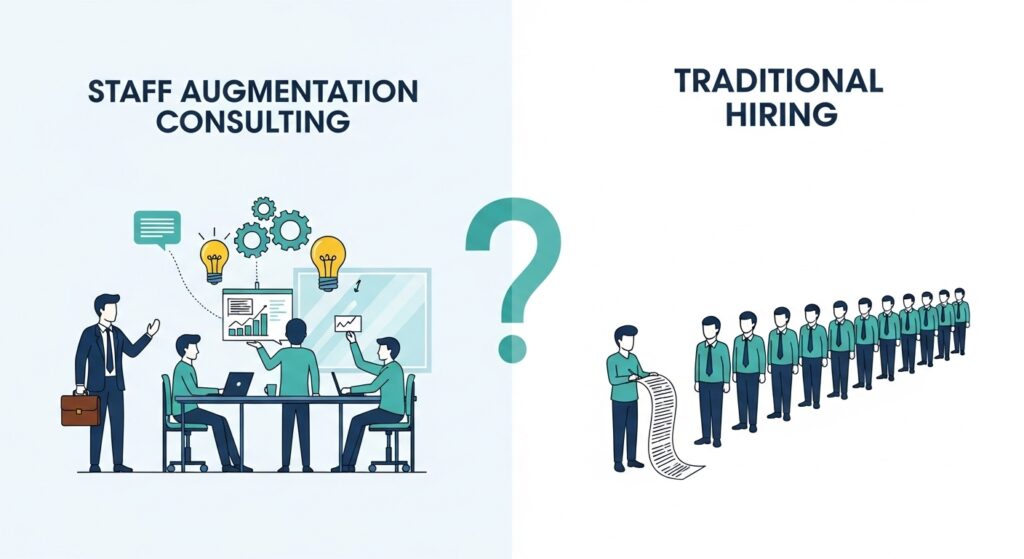
Traditional hiring works best when the business has a stable, ongoing need and enough time to recruit carefully. Staff augmentation works better when the business needs capability without long-term commitment, or speed without the delay of a full hiring cycle.
That is why the choice should be based on the shape of the problem, not on habit.
Choose augmentation when the work is important, but not permanent
This is one of the clearest signals.
Many business needs are serious, high-impact, and time-sensitive, but they are not permanent roles. A system implementation, product launch, migration, transformation project, or temporary delivery spike may require strong talent, but only for a fixed window.
Hiring full-time for that kind of work often creates a mismatch. The business solves the short-term pressure, but then has to absorb the long-term cost of a role that may not be needed in the same way later.
In those cases, augmentation gives you something traditional hiring cannot easily provide: the ability to match talent to the life of the need.
Choose augmentation when time matters more than org chart planning
There are moments when a business simply cannot wait.
A project is behind. A client deadline is locked. A technical gap is slowing delivery. A key team member has left unexpectedly. In these situations, hiring the “perfect permanent candidate” can become a luxury the business cannot afford.
Traditional recruitment often takes weeks or months. Even after selection, there is usually notice period, onboarding, and ramp-up time. That might work for planned growth. It does not work well for urgent execution gaps.
Augmentation is often the better choice when the cost of waiting is higher than the cost of bringing in outside support.
Choose augmentation when you need capability, not headcount
This is where many companies make the wrong call.
They assume they need more people when in reality they need a very specific kind of expertise. That could be a Dynamics consultant, integration specialist, cloud architect, data engineer, QA automation lead, or another niche skill that is hard to hire and may not be needed forever.
A permanent hire in that scenario can be inefficient. The recruitment process is harder, the salary expectations may be higher, and the role itself may not stay equally relevant once the project phase ends.
Augmentation lets the business buy access to capability instead of committing to headcount for its own sake.
Choose augmentation when your internal team is good, but overloaded
Sometimes the smartest move is not to replace your team or expand it permanently. It is protecting it.
Strong internal teams still hit capacity limits. High performers get stretched. Managers start firefighting. Quality slips because the same people are trying to cover delivery, internal coordination, client needs, and strategic priorities simultaneously.
That is often the point where augmentation adds the most value.
It gives the business breathing room. It helps protect internal momentum. And it prevents a short-term pressure spike from turning into burnout, delay, or avoidable mistakes.
This is especially useful when you already have internal ownership and domain knowledge, but need extra execution power to keep things moving.
Choose augmentation when flexibility is part of the business model
Not every business operates with predictable demand.
Some companies grow in bursts. Some work project to project. Some deal with seasonal workload changes. Some scale fast in one area while another area slows down. In these environments, fixed hiring can be risky because the workforce structure lags behind business reality.
Augmentation fits better when agility matters.
It lets leaders scale talent based on actual workload rather than making every resourcing decision permanent. That flexibility is not just operationally useful. It is also financially smarter, especially when future demand is hard to forecast with confidence.
Traditional hiring is better when ownership matters more than speed
This is the point where the decision becomes clearer.
If the role is central to long-term business ownership, culture, leadership continuity, or internal knowledge building, then traditional hiring usually makes more sense. Permanent roles are better when the business is building lasting capability and needs someone to grow with the function over time.
But when the need is tied to delivery, transition, specialist execution, or temporary demand, augmentation often wins because it is better aligned with the business reality.
In other words, hire when you need ownership. Augment when you need acceleration.
The cost conversation is often misunderstood
Many businesses compare augmentation and traditional hiring too narrowly. They look at salary versus contract rate and stop there.
That is not the full picture.
The real cost of traditional hiring includes recruiter time, leadership involvement, productivity delays, onboarding effort, benefits, retention risk, and the risk of hiring the wrong person. It also includes the opportunity cost of missed timelines while the business waits.
That is why augmentation can sometimes look more expensive on paper but be more cost-effective in practice. It reduces delay, adds immediate value, and avoids locking the business into fixed costs when the need may not last.
A simple way to decide
Before choosing between augmentation and hiring, ask four questions:
- How urgent is the need?
- How long will the need last?
- Is the skill specialized or general?
- Do we need execution support or long-term ownership?
Those four questions usually reveal the right answer quickly.
If the need is urgent, time-bound, and specialist-heavy, augmentation is often the stronger option.
If the need is stable, long-term, and tied to internal ownership, hiring is usually the better path.
Final thoughts
The best staffing decisions are not based on what companies usually do. They are based on what the business actually needs right now.
Staff augmentation consulting makes the most sense when speed, flexibility, and specialized support matter more than permanent headcount. It helps businesses move faster, protect internal teams, and solve delivery problems without overcommitting on structure.
Traditional hiring still matters. But it should not be the automatic answer to every gap. Sometimes the smarter move is not to hire slower. It is to solve the problem more precisely.