
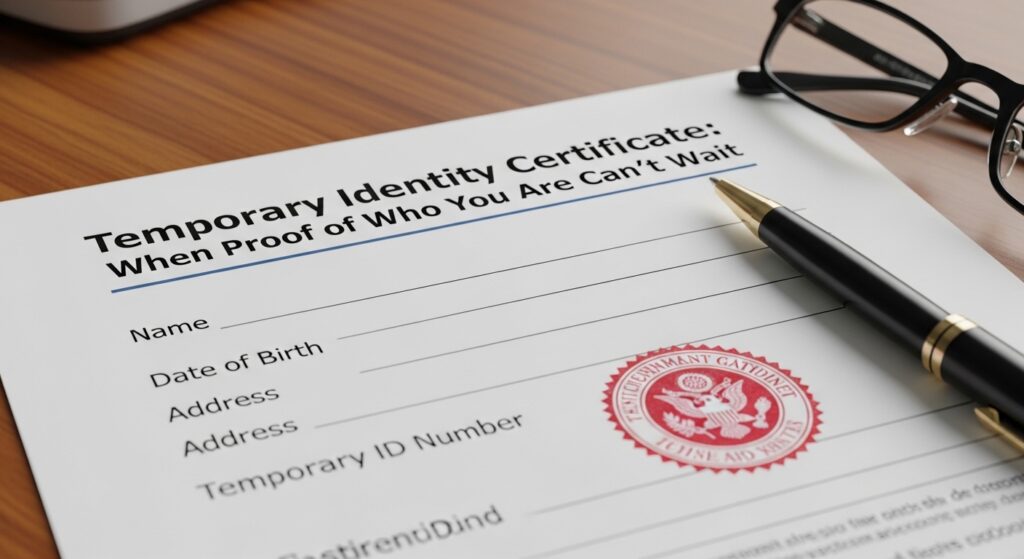
At 6:45 a.m., in a crowded government office hallway, a university student clutched a thin sheet of paper as if it were a passport to her future. Her wallet had been stolen the night before a flight tied to a scholarship interview abroad. Without identification, she couldn’t board the plane. Without boarding the plane, months of work would unravel.
What she received that morning wasn’t a permanent ID card. It wasn’t laminated or biometric. It was something far less glamorous but equally powerful: a temporary identity certificate.
In moments of urgency—lost documents, expired IDs, pending renewals, refugee processing, legal transitions—a temporary identity certificate becomes more than paper. It becomes a bridge between disruption and continuity. For institutions, it maintains order. For individuals, it restores agency.
Understanding how it works, when it applies, and why it matters can prevent confusion during some of life’s most stressful situations.
What Is a Temporary Identity Certificate?
A temporary identity certificate is an official document issued by a recognized authority—typically a government agency—that verifies a person’s identity for a limited period. It acts as a provisional substitute when a standard identification document is unavailable, lost, under renewal, or still being processed.
Unlike permanent ID cards or passports, temporary certificates usually have a defined validity window, often ranging from a few days to several months. They are designed to serve a specific purpose: enabling the holder to access services, travel domestically in certain cases, complete legal procedures, or prove identity while awaiting formal documentation.
The format varies by country. Some are printed letters with official seals and signatures. Others include QR codes, barcodes, or digital verification links. What they share is institutional backing and time-bound legitimacy.
Why They Matter in a High-Trust Society
Modern societies run on identity verification. From opening bank accounts to enrolling in school, from signing contracts to receiving medical care, proof of identity underpins nearly every civic interaction.
When that proof disappears—through theft, disaster, bureaucratic delay, or administrative change—life doesn’t pause. Bills are still due. Flights still depart. Deadlines still arrive.
For governments, it reduces systemic friction. Without such mechanisms, agencies would face waves of stalled transactions and vulnerable populations unable to access essential services. For individuals, it prevents cascading consequences. A missed exam registration or delayed job onboarding can have long-term ripple effects.
In crisis scenarios—natural disasters, displacement, or conflict—temporary identity documentation can be lifesaving. It allows displaced individuals to register for aid, cross checkpoints, or access healthcare.
Common Situations Where It’s Issued
Though regulations vary globally, several scenarios frequently trigger the issuance of a temporary identity certificate.
One of the most common is document loss or theft. After reporting the loss, authorities may issue a provisional certificate while a new ID card or passport is being produced.
Another situation involves expired identification. In some jurisdictions, processing delays mean applicants must wait weeks or months for renewed documents. A temporary certificate ensures continuity during that waiting period.
Legal transitions also play a role. Individuals undergoing name changes due to marriage, divorce, or gender transition may require temporary documentation reflecting updated information while permanent IDs are being reissued.
For migrants, asylum seekers, or refugees, temporary identity certificates often serve as foundational documentation during status determination processes. These certificates confirm that the holder is registered with authorities and legally present under specific conditions.
Students and temporary workers sometimes receive similar documents while residence permits are under review.
What a Temporary Identity Certificate Typically Includes
Despite being temporary, these documents are not informal. They usually contain key identifying elements such as:
-
Full legal name
-
Date and place of birth
-
Photograph (in many cases)
-
Unique identification or case number
-
Issuing authority and official stamp or seal
-
Date of issue and expiration
Some jurisdictions now integrate digital verification features, allowing institutions to scan a code or access an online portal to confirm authenticity.
The inclusion of security elements is critical. Because temporary certificates can be more vulnerable to forgery than permanent IDs, governments often embed watermarks, holographic stickers, or encrypted digital references.
Limitations and Legal Boundaries
A temporary identity certificate is not a universal replacement for all identification purposes. Its scope is often limited by law.
For example, it may be accepted for domestic administrative tasks but not for international travel. Some financial institutions may require additional documentation before opening accounts. In high-security environments—airports, border crossings, government facilities—acceptance may depend on supplementary proof.
The expiration date is non-negotiable. Once lapsed, the certificate typically loses all legal standing.
Understanding these limitations is essential. Misinterpreting the scope of temporary documentation can lead to denied access, missed opportunities, or legal complications.
The Digital Shift: E-Temporary Identity Certificates
As digital infrastructure expands, many governments are moving toward electronic temporary identity certificates.
These digital versions may be delivered via secure government portals, mobile apps, or encrypted email systems. In some countries, temporary credentials are linked directly to national digital identity frameworks, allowing real-time verification.
The advantages are clear. Digital certificates reduce printing costs, minimize forgery risks, and enable faster issuance. They can also be revoked or updated instantly if errors are identified.
However, the digital shift raises equity concerns. Not all citizens have equal access to smartphones, reliable internet, or digital literacy. Policymakers must balance innovation with accessibility to avoid excluding vulnerable populations.
Institutional Perspective: Why Governments Use Them
From an administrative standpoint, temporary identity certificates are a risk management tool.
They allow governments to maintain continuity while background checks, biometric processing, or database updates are underway. Rather than delaying all transactions until final documents are ready, authorities can offer conditional recognition.
This flexibility reduces pressure on public services. It also enhances resilience during unexpected events such as system outages or sudden spikes in demand.
Moreover, temporary certificates create traceable records. Each issuance is logged, creating a paper or digital trail that strengthens accountability.
Security and Fraud Concerns
Because temporary documents can be perceived as easier to manipulate, they carry inherent fraud risks.
Authorities counter this with layered safeguards: centralized databases, verification hotlines, scannable codes, and tamper-evident design elements. Institutions receiving such certificates are often encouraged to verify authenticity directly with issuing agencies.
Individuals should treat temporary identity certificates with the same care as permanent IDs. Loss or misuse can lead to identity theft or legal complications.
The balance between accessibility and security defines the credibility of these documents. Too many barriers defeat their purpose; too few undermine trust.
Global Variations
There is no universal model for temporary identity certificates.
In some countries, they are standardized nationwide. In others, local authorities issue region-specific versions. Immigration systems may use entirely different formats compared to civil registries.
International recognition is rare. A temporary certificate issued in one country is typically valid only within that jurisdiction unless specific bilateral agreements exist.
For travelers or expatriates, this distinction matters. Temporary domestic documentation rarely substitutes for a passport abroad.
Human Impact: Beyond Bureaucracy
It’s easy to view identity documentation as an administrative routine. Yet behind every temporary certificate lies a personal story—loss, urgency, transition, or displacement.
Consider someone rebuilding after a house fire. Or a refugee navigating a new legal system. Or a professional waiting for renewed credentials to start a job. In each case, temporary proof of identity is more than compliance. It’s reassurance.
Identity is foundational to participation in society. When that foundation is shaken, temporary certification restores a measure of stability.
Best Practices for Individuals
If you ever require a temporary identity certificate, several steps can help ensure smooth processing.
Report lost or stolen documents immediately. Provide supporting documentation such as birth certificates, police reports, or expired IDs. Confirm the certificate’s validity period and understand where it will be accepted.
Keep both digital and physical copies when possible, and verify whether additional documents are needed for specific transactions.
Most importantly, track the status of your permanent replacement. Temporary solutions are designed to bridge gaps, not replace final documentation.
A Small Document with Significant Weight
The student at the airport made her flight. The certificate, stamped and signed just hours earlier, was accepted by airline authorities after verification. Weeks later, her new ID card arrived in the mail.
The temporary identity certificate had done exactly what it was designed to do: hold the line between disruption and resolution.
In a world increasingly dependent on formal identification, these provisional documents play a quiet but critical role. They reflect an understanding that life doesn’t pause for paperwork. Systems must adapt to human reality—not the other way around.
Temporary identity certificates may be short-lived, but their impact can be lasting. In moments of uncertainty, they affirm a simple truth: even when documents go missing, identity endures.