
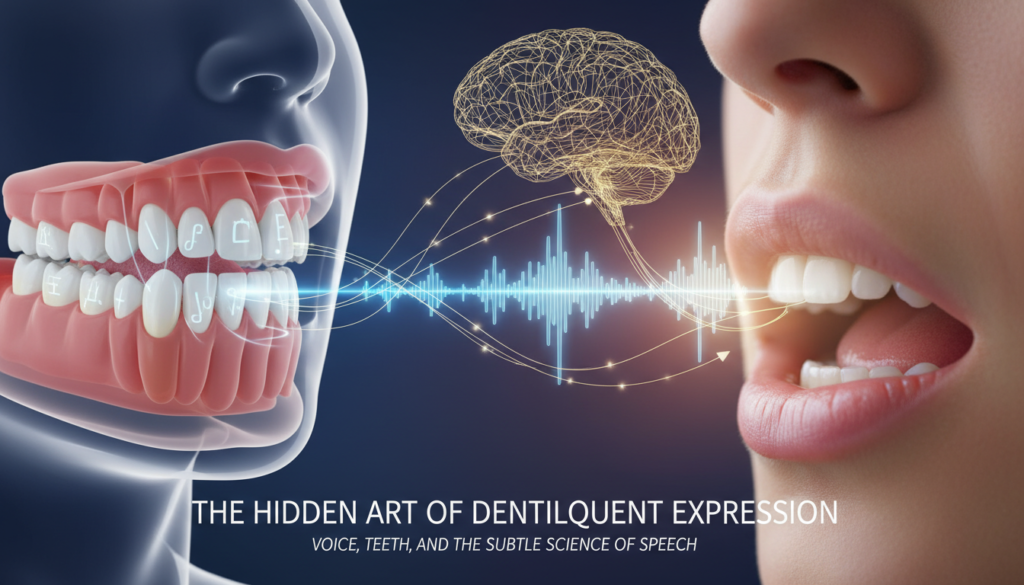
Language is more than vocabulary and grammar. It is a symphony of breath, muscle, bone, and intention. Among the many fascinating terms that describe how we speak, dentiloquent stands out as both rare and evocative. It refers to speaking or pronouncing words with the teeth, emphasizing the role of dental articulation in speech production.
Though seldom used in everyday conversation, dentiloquent captures an essential aspect of human communication. From crisp consonants to sharp enunciation, our teeth shape the sounds we make in ways we often overlook. This article explores the meaning, origins, mechanics, cultural relevance, and future implications of dentiloquent speech in a world increasingly dominated by digital communication.
What Does dentiloquent Really Mean?
At its core, dentiloquent describes speech that is articulated with noticeable use of the teeth. The word stems from Latin roots: dens (tooth) and loqui (to speak). Together, they form a concept that literally means “speaking with the teeth.”
But dentiloquent is not simply about having teeth. It highlights how the teeth interact with the tongue, lips, and airflow to produce distinct sounds—particularly consonants like th, f, v, and certain s sounds.
In phonetics, these are often referred to as dental or labiodental sounds. When someone speaks in a distinctly dentiloquent manner, their pronunciation may sound crisp, sharp, or carefully enunciated.
The Science Behind dentiloquent Speech
Speech production is a finely coordinated physical process. To understand dentiloquent articulation, we must examine how sound is formed.
Air begins in the lungs, travels up through the vocal cords, and resonates through the mouth. The tongue, lips, palate, and teeth then shape this airflow into recognizable sounds.
When producing dental sounds:
-
The tongue touches or approaches the teeth.
-
The teeth create a barrier or channel for airflow.
-
Subtle adjustments in pressure produce different phonetic effects.
For example:
-
The “th” in think requires the tongue to rest lightly between the teeth.
-
The “f” in fine involves the lower lip pressing against the upper teeth.
-
The “v” in voice uses a similar motion to vocal cord vibration.
These interactions make dentiloquent speech possible and essential to many languages.
Why dentiloquent Sounds Matter in Communication
Clear articulation improves comprehension. Dentilo-quent sounds often distinguish between words that would otherwise be confused. Consider:
-
Think vs. Sink
-
Fine vs. Pine
-
Then vs. Den
Without precise dental articulation, clarity suffers.
In public speaking, acting, broadcasting, and teaching, dentiloquent precision is highly valued. Speakers who clearly pronounce dental consonants often appear more confident, educated, and persuasive. Though this perception may be subjective, it influences social and professional interactions.
Dentiloquent in Linguistics and Phonetics
The Role of dentiloquent in Phonetic Classification
In phonetics, speech sounds are classified based on their place and manner of articulation. Dentiloquent speech relates specifically to dental and labiodental consonants.
Dental consonants occur when the tongue touches the upper teeth. Labiodental consonants occur when the lower lip contacts the upper teeth. Both fall under the broader umbrella of dentiloquent articulation.
Languages vary widely in their use of dental sounds:
-
English relies heavily on dental and labiodental consonants.
-
Spanish includes dental sounds but pronounces them differently.
-
Hindi features retroflex consonants that shift slightly away from pure dental placement.
Understanding dentilo-quent patterns helps linguists trace language evolution and regional accents.
Cultural Perspectives on dentiloquent Speech
Speech patterns often carry cultural significance. In some societies, sharp and precise articulation signals education and refinement. In others, softer or less dentally pronounced speech feels more natural and authentic.
For example:
-
British Received Pronunciation emphasizes crisp consonants.
-
Certain American regional accents soften dental sounds.
-
French pronunciation uses teeth differently, creating distinct tonal qualities.
Thus, dentiloquent expression becomes a marker of identity. It shapes how people perceive background, region, and even personality.
Dentiloquent and Professional Voice Training
Why Actors Study dentiloquent Techniques
Actors undergo rigorous voice training to enhance clarity and projection. Dentiloquent articulation exercises are common in drama schools.
These exercises may include:
-
Repeating tongue twisters emphasizing “th” and “f” sounds.
-
Over-enunciating consonants to strengthen mouth muscles.
-
Practicing breath control to support sharp articulation.
For broadcasters, dentiloquent clarity ensures audiences understand every word. Microphones amplify subtle mispronunciations, making precision even more critical.
Singers also benefit from understanding dental placement. Though vowels dominate singing, consonant clarity ensures lyrics remain intelligible.
Speech Therapy and dentiloquent Development
Children and individuals with speech disorders often struggle with dental sounds. Common difficulties include:
-
Lisping (substituting “th” with “s” or “z”).
-
Omitting labiodental sounds.
-
Misplacing the tongue during articulation.
Speech therapists use targeted exercises to develop dentiloquent control. These may involve mirrors, tactile cues, and repetition drills.
Correcting dentiloquent errors improves not only clarity but also confidence. Many clients report feeling more comfortable in social settings after mastering dental articulation.
The Psychology of dentiloquent Expression
Speech influences perception. Research suggests listeners associate clear articulation with intelligence and competence. Dentilo-quent precision, therefore, can subtly shape impressions.
However, excessive emphasis may sound artificial or theatrical. The key lies in balance—using natural but accurate dental articulation.
Psychologically, mastering dentilo-quent speech can boost self-esteem. When individuals feel understood, they experience less anxiety and greater willingness to communicate.
Technology and the Future of dentiloquent Communication
In the age of voice assistants and artificial intelligence, dentiloquent articulation affects technology interaction.
Speech recognition systems rely on accurate phonetic input. Slurred or imprecise dental sounds may cause misunderstandings with virtual assistants like Siri or Alexa.
As voice-based interfaces expand, awareness of dentiloquent clarity becomes increasingly relevant. Clear articulation improves machine comprehension and reduces frustration.
Similarly, text-to-speech systems are programmed to simulate realistic dental articulation. Engineers analyze human dentiloquent patterns to make synthetic voices sound natural.
How Dental Health Influences dentiloquent Speech
Teeth are not merely passive participants in speech. Their alignment, spacing, and condition directly impact articulation.
Orthodontic issues such as:
-
Overbites
-
Underbites
-
Missing teeth
-
Misaligned incisors
can alter dentiloquent sounds.
For instance, a gap between front teeth may create a whistling effect on “s” sounds. Braces temporarily change airflow patterns, affecting pronunciation.
Dentists and orthodontists recognize speech as an important factor in treatment planning. Improving dental structure often enhances dentilo-quent clarity.
Exercises to Improve dentiloquent Precision
Anyone can strengthen their dental articulation through practice. Consider the following techniques:
-
Mirror Practice
Watch your tongue placement while producing “th,” “f,” and “v” sounds. -
Exaggeration Drills
Overemphasize dental sounds to build muscle memory. -
Tongue Twisters
Try phrases like:
“Thirty-three thieves thought they thrilled the throne.” -
Slow Reading Aloud
Focus on crisp consonants and controlled airflow. -
Breathing Techniques
Support speech with diaphragmatic breathing for consistent projection.
Regular practice improves dentiloquent strength and overall speech clarity.
Dentiloquent in Literature and Rhetoric
Though rarely used in casual writing, the word dentilo quent occasionally appears in literary analysis or poetic descriptions. Authors may use it to characterize a speaker whose words sound clipped, sharp, or precise.
In rhetoric, attention to dentilo quent articulation enhances persuasive power. Great orators throughout history mastered consonant clarity to captivate audiences.
Martin Luther King Jr., Winston Churchill, and other renowned speakers demonstrated exceptional control over dental consonants, ensuring their messages resonated clearly in large spaces without modern amplification.
Social Media and the Changing Nature of dentiloquent Expression
Ironically, as communication shifts toward texting and typing, awareness of physical speech mechanics may decline. Emojis and abbreviations replace spoken nuance.
Yet podcasts, video content, and livestreaming are reviving interest in vocal quality. Content creators invest in microphones, acoustic treatment, and vocal coaching to achieve professional clarity.
Dentilo quent articulation plays a subtle but powerful role in audience retention. Clear consonants reduce listener fatigue and enhance credibility.
Common Misconceptions About dentiloquent Speech
-
It Means Speaking Through Clenched Teeth
Dentiloquent refers to using the teeth in articulation, not speaking angrily or tensely. -
It Indicates Elitism
Clear dental articulation does not imply superiority. It is simply a phonetic feature. -
It Is Rare or Unnecessary
In truth, dentiloquent articulation is fundamental to many languages.
Understanding these distinctions prevents confusion and encourages appreciation of speech mechanics.
The Subtle Beauty of dentiloquent Sound
Human speech is a marvel of coordination. The teeth, often taken for granted, serve as silent architects of clarity. Dentilo quent articulation transforms breath into meaning with remarkable precision.
Consider how small adjustments change sound entirely. A millimeter of tongue movement can shift “think” into “sink.” Such subtlety reveals the delicate engineering behind everyday conversation.
Dentiloquent expression reminds us that communication is physical as well as intellectual.
Conclusion
Though the word dentiloquent may not appear in daily vocabulary, the concept it represents is woven into every conversation. From professional broadcasting to childhood speech development, dental articulation shapes how we connect and understand one another.
In an era of rapid technological advancement and evolving communication platforms, clarity remains essential. By appreciating and refining dentilo quent precision, we honor one of the most intricate aspects of human expression.
Speech begins with breath—but it finds its sharpest edges against the teeth. And within that delicate contact lies the enduring power of dentilo quent communication.