On a Tuesday afternoon in a co-working space in Austin, a startup founder refreshed her inbox for the third time in ten minutes. She had posted a job opening two weeks earlier and received 186 applications. Only six were remotely relevant. The rest were a blur of generic resumes, keyword-stuffed cover letters, and mismatched expectations.
Across the country, a skilled product designer scrolled through job listings that all seemed to say the same thing. “Fast-paced.” “Rockstar.” “Competitive compensation.” None of it told her what she actually wanted to know: Who would she work with? What would she build? Would her ideas matter?
This disconnect is not new—but it’s becoming more expensive. Time lost in hiring cycles, disengaged employees, and high turnover rates quietly erode growth. Platforms like WorkConnect are emerging in response to that friction, promising not just job matching, but alignment.
The real question is not whether another professional networking tool is needed. It’s whether the way we connect talent and opportunity can evolve beyond static resumes and algorithmic guesswork.
The Problem with Traditional Hiring Ecosystems
For decades, recruitment has revolved around two core tools: resumes and job boards. Both are transactional by design. They list skills, titles, and requirements, but they rarely capture context.
A resume tells you where someone worked. It doesn’t tell you how they think. A job description lists responsibilities. It doesn’t reveal the team’s working style or decision-making culture.
As remote and hybrid work models expand, this gap widens. When teams are distributed across time zones, cultural alignment and communication style matter as much as technical competence. Yet most hiring systems still filter primarily by keywords.
This is where the concept behind WorkConnect becomes relevant. Instead of focusing purely on credentials, it attempts to build connections around shared goals, work preferences, and project-based compatibility.
What Is WorkConnect?
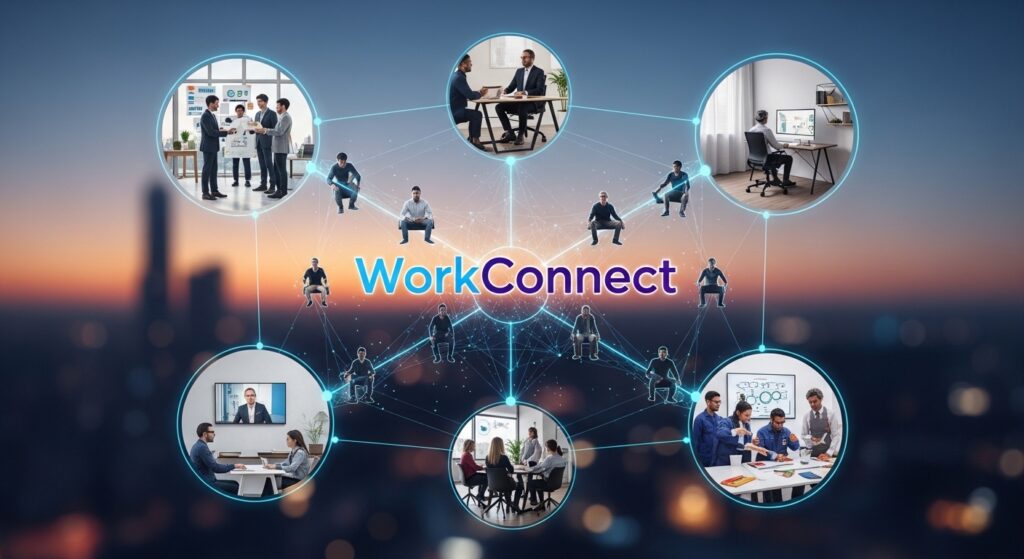
WorkConnect is best understood as a professional connection ecosystem rather than a conventional job board. Its core idea centers on aligning professionals and organizations based on how they work, not just what they have done.
While implementations may vary by region or industry focus, the underlying structure typically includes detailed professional profiles, skill-validation mechanisms, project-collaboration features, and intelligent matching tools.
Rather than treating hiring as a one-time event, WorkConnect-style platforms often position themselves as ongoing relationship networks. Professionals showcase portfolios, publish insights, and participate in micro-projects. Employers observe performance in context rather than relying solely on interviews.
The emphasis shifts from static evaluation to dynamic interaction.
From Resumes to Real Work
One of the most significant shifts platforms like WorkConnect introduce is the move toward demonstrable capability.
Instead of asking, “Where did you work before?” companies can ask, “What have you built recently?” Designers can upload prototypes. Developers can link repositories. Strategists can outline campaign case studies with measurable outcomes.
This evolution benefits both sides.
For candidates, it reduces the pressure of fitting into rigid job descriptions. For employers, it decreases hiring risk by providing clearer insight into actual skill levels.
More importantly, it reframes professional identity. People are no longer defined solely by titles but by contributions.
The Rise of Project-Based Collaboration
The modern workforce is increasingly fluid. Freelancers, consultants, fractional executives, and remote contractors are not edge cases—they are integral parts of business strategy.
WorkConnect platforms often integrate short-term project matching alongside traditional employment opportunities. A startup might seek a cybersecurity consultant for a two-week audit. A marketing team might need a copy strategist for a product launch.
This modular approach reflects how companies actually operate today. Teams expand and contract based on needs. By enabling project-based collaboration, WorkConnect-style systems mirror real-world workflow rather than forcing everything into permanent roles.
For entrepreneurs and founders, this flexibility translates into cost efficiency and agility. Instead of committing to long-term hires prematurely, they can validate collaboration through smaller engagements.
Culture as a Matching Variable
Technical skills can be learned. Cultural misalignment is harder to fix.
One emerging feature in modern professional platforms is the integration of work-style indicators. These may include preferences around communication frequency, decision-making speed, autonomy levels, or feedback structures.
By incorporating these dimensions, WorkConnect moves closer to holistic compatibility. A highly independent product manager may thrive in a flat organizational structure but struggle in a heavily layered hierarchy. Traditional resumes rarely reveal this nuance.
When alignment improves, retention tends to follow. Reduced turnover saves companies recruitment costs and preserves institutional knowledge.
Technology Under the Hood
At the core of WorkConnect’s functionality lies data intelligence.
Matching algorithms analyze not only keywords but patterns—project types, collaboration history, peer endorsements, and even engagement behavior within the platform. Machine learning models refine recommendations over time, ideally increasing relevance with each interaction.
However, the real differentiator is not the algorithm alone. It’s the quality of data input. Platforms that encourage detailed, authentic profiles tend to produce better matches than those relying on minimal user information.
Security and privacy also play a critical role. Professional data is sensitive. Transparent policies and encrypted systems are essential for user trust.
A Comparative Snapshot
To understand how WorkConnect differs from traditional platforms, it helps to look at key distinctions:
| Feature | Traditional Job Board | Professional Network | WorkConnect Model |
|---|---|---|---|
| Resume-Centric | Yes | Mostly | No |
| Project-Based Matching | Rare | Limited | Core Feature |
| Skill Demonstration | Minimal | Moderate | Emphasized |
| Culture & Work Style Metrics | Rare | Emerging | Integrated |
| Ongoing Collaboration | Limited | Networking Only | Active |
| AI-Driven Compatibility | Basic Filters | Moderate | Advanced |
This comparison highlights the shift from static listings to interactive ecosystems.
Benefits for Founders and Growing Teams
For early-stage companies, hiring mistakes are disproportionately costly. A single misaligned hire can delay product launches, strain budgets, and affect morale.
WorkConnect-style platforms offer three distinct advantages.
First, they reduce time-to-alignment. By filtering beyond surface-level qualifications, founders spend less time sorting irrelevant applications.
Second, they enable talent discovery beyond geography. Remote compatibility tools open access to global professionals without sacrificing cohesion.
Third, they encourage incremental engagement. Trial projects provide insight before long-term commitments are made.
For startups operating with limited runway, these efficiencies can make a measurable difference.
Empowering Professionals in a Competitive Market
On the other side of the equation, professionals face increasing competition. Automated resume screening often eliminates strong candidates before a human ever reviews their profile.
WorkConnect’s emphasis on visible work output levels the playing field. Independent creators, career changers, and self-taught technologists can demonstrate competence without relying solely on pedigree.
This democratization of visibility aligns with broader workforce trends. Skills are evolving faster than degree programs. Platforms that reflect real capability rather than institutional affiliation are better suited to modern labor markets.
Challenges and Considerations
Over-reliance on algorithms can unintentionally reinforce bias if training data reflects historical inequalities. Transparency in matching logic is essential.
Additionally, not all industries lend themselves equally to project-based evaluation. Highly regulated sectors may require formal certifications that cannot be bypassed.
Adoption also depends on network effects. A platform’s value grows as participation increases. Without critical mass, even the most innovative features struggle to gain traction.
For WorkConnect to succeed long term, it must balance innovation with inclusivity and scale.
The Future of Professional Connection
The workplace is undergoing structural transformation. Remote-first policies, cross-border hiring, and digital collaboration tools are reshaping expectations.
In this environment, the question is no longer “Where do you work?” but “How do you work?” and “What can you build?”
WorkConnect represents an attempt to answer those questions more intelligently. By shifting focus from static credentials to dynamic compatibility, it reflects a broader movement toward performance transparency and cultural fit.
The founder in Austin eventually found her designer—not through a mass application portal, but through a collaborative micro-project that revealed both technical skill and creative chemistry. The hiring decision felt less like a gamble and more like a natural next step.
As professional ecosystems continue to evolve, platforms that prioritize connection over mere listing will likely define the next chapter of work.
WorkConnect is not just another tool in the recruitment stack. It signals a recalibration—one that acknowledges that work is human, contextual, and collaborative at its core.